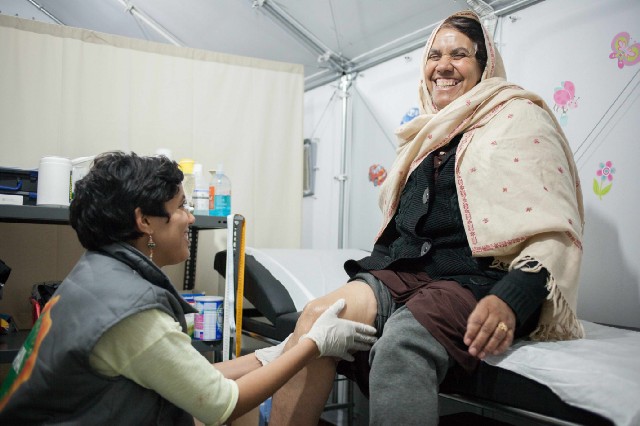
from a WAHA staff on the island of Samos, Greece
@MBengoa
#GenerationEqualityForum contribution
In 2011, my career shifted from a field-based role at Unicef West and Central Africa to a donor position, when I joined a leading French luxury company. My horizon was then very centered on people and health, women’s reproductive choices, and preserving childhood survival gains in some of the most deprived countries in Africa. I have become a feminist by exposure to inequalities, not within my privileged and protected background, rather from standing among many women in hardship, hearing their stories, and being moved and transformed by their courage.
We are now less than 10 years before closing the 2030 SDG agenda, with nearly 30 years of progress brutally drawn back due to the Covid-19 pandemic. And today the #GenerationEquality Forum has kicked off, with over 40 000 activists and authorities gathering in Paris to relaunch the global commitments for women and girls’ rights.
This article opens a discussion on my learnings from building the French National Committee for UN Women and my tenure at the helm of a gender focussed corporate foundation. This experience as a gender advocate is now enriching the support and advice provided to a leading social economy group which will to contribute to the global debate and action coalitions to make gender equality real by 2030.
The wide community that contributed to enlightening my understanding of the complexities behind gender bias, stereotypes, and other essential barriers has been remarkable. I wish to extend my gratitude for each person’s openness to dialogue and genuine interest to drive change for women in the world. From Cameroon to the suburbs of Paris, and from Quito’s indigenous populations to the girls of Bihar, I have been humbled to learn about their struggles, the oppression, and the clear needs that they expressed: in principle, society made them feel less than men, their voices were seldom heard and respected, their bodies were at the mercy of others. This has nourished a contrasted feeling: as a person in a position to provide support, funding, and other benefits to organizations working for the advancement of women’s rights, there was no room for complacency and middle ground commitments. We needed to be bold and decisive in our choices.
The many stages of the foundation’s development are an untold story. Yet it is possibly the right time to share some insights that have guided this important work. These years of discovery have forged my ability to lead and defend a strong stance for strategic philanthropy for gender equality. I can witness the positive teamwork and tremendous organizational change that occurred within our realm of action.
This series will provide evidence of collective lessons learned from this trial and error period, to share with the wider community of funders and gender activists. It will develop some practical frameworks to design and refine strategies that favor the empowerment and lasting independence of girls and women. I also wish to highlight the very wise advice received from the most prominent women organizations and movement builders, from over 30 countries where the foundation is currently active and in the many regions and networks that ONU Femmes France has supported.
Since I stepped down in late 2020 from my role as Executive Director, I have explored the opportunity to pursue many of these recommendations within the social and inclusive economy sector as well. Building bridges between corporate philanthropy and the wider social sector has been an honor and a daily commitment during the past decade. I hope that the results for end-line beneficiaries and the partner organizations who attended to their needs can be sustained and leveraged further. There can be many new stages of growth for partner organizations, NGOs and local women’s movements, with the support of a rising number of gender-transformative investors and donors.
I also commend my colleagues and friends at UN Women, whose talent at navigating the gender landscape and diplomatic arenas is unprecedented. The synchronous creation of a French National Committee for UN Women starting in 2012 has ultimately anchored my feminist positioning and has irrigated much of the work at the foundation as well. Thanks to the grantmaking perspective at the foundation and direct advocacy developed by ONU Femmes France, the range of possibilities to promote change for women and advance the gender equality agenda became endless. I draw from both these experiences for the following discussions and examples.
The chapters will cover some of the particularities of funding programs intended to promote the agency of women and girls. The projected list of topics is provided below, starting on time for the launch of the Generation Equality Forum in July 2021.
Follow my thread to stay informed of new publications. Looking forward to your feedback and comments
Miren
10 Years to Advance Change for Women and Girls
Chapter 1: Making choices within a holistic approach
Chapter 2: Growing capacity to operate globally
Chapter 3: Building alliances to attract attention and opportunities
Chapter 4: Selecting the best and innovative projects
Chapter 5: Triggering change inside and outside the organization
Chapter 6: Changing mindsets by setting the example
Chapter 7: A slow start for big results
Chapter 8: Increasing the funding capacity of organizations
Chapter 9: Measuring change to evolve with agility
Chapter 10: Women leaders or women taking the lead?
Conclusions


Leave a Reply